Reference Projects
Portal System
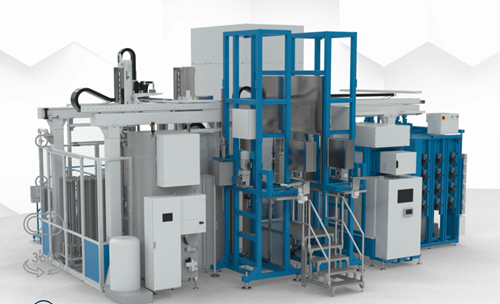
Portal systems enable precise positioning and movement of workpieces for various processing steps.
e.g., steam vulcanization for rubber parts
Advantages for You as a Customer:
- Optimized Manufacturing Processes: Seamless movement of workpieces between different processing stations for a more efficient production workflow.
- High Repeatability: Precise and repeatable motion sequences ensure consistent product quality.
- Reduced Manual Labor: Minimizes the need for manual intervention, lowering the risk of human errors.
- Handling Versatility: Scalable for movements in multiple dimensions, simplifying production planning and execution, and enabling swift material flow across long distances within the facility.
- Large Working Areas: Ideal for processing larger workpieces or assemblies.
- Higher Load Capacity: Capable of handling heavier loads, reducing labor for employees and minimizing the risk of overload damage.
- Compact Design: Allows for tighter integration between interconnected processing stations, operating without the need for personnel intervention.
Automated portal systems enhance efficiency, flexibility, and quality in production facilities.
Functionality and Structure:
A portal system consists of a sturdy gantry that spans across the manufacturing area of a facility, serving as the core structure. Mounted on this gantry are motion units that operate along horizontal and vertical axes. These units enable precise movement and positioning of workpieces in multiple dimensions, ensuring accurate processing.
Production Cell
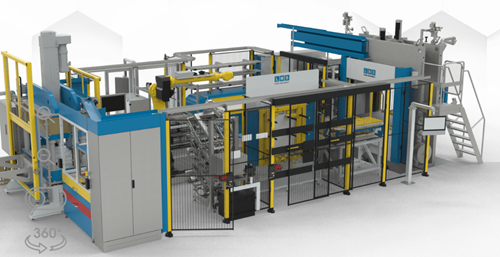
Production cells as automated manufacturing systems enable simultaneous processing of workpieces at multiple stations within a single cell, thereby increasing efficiency and productivity.
e.g., for cylinder head gaskets
Advantages for You as a Customer:
- Precise Manufacturing: Each station is optimized for specific tasks, ensuring high product quality.
- Increased Efficiency: Simultaneous processing at multiple stations reduces production times.
- Flexibility: Stations can be adapted to various production requirements, allowing for quick responses to market demands.
- Reduced Manual Labor: Automated systems minimize human errors and enhance efficiency.
Functionality and Structure:
A production cell comprises multiple processing stations arranged in a specific layout within the cell. These stations facilitate various tasks such as cutting, shaping, drilling, and assembly. Workpieces progress through these stations until all processing steps are completed. The production cell ensures seamless execution of processing steps and is crucial for efficient production.
Rotary Table System
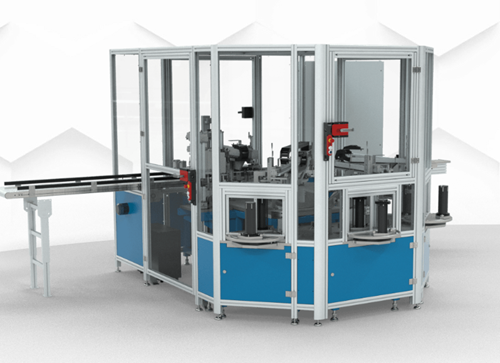
Rotary tables as automated manufacturing systems enable precise positioning and movement of workpieces to perform various processing steps simultaneously.
e.g., welding system for metal rings
Advantages for You as a Customer:
- Precise Positioning: Enables exact positioning of workpieces through precise control of the circular path, supporting critical manufacturing processes.
- Flexibility: Handles various workpieces without costly and time-consuming changeovers.
- High Accuracy and Reproducibility: Ensures consistent product quality through precise and repeatable motion sequences.
- High Repeatability: Automated processes ensure consistent product quality.
- Space Savings: The compact arrangement maximizes space utilization within the facility.
- Optimized Manufacturing Processes: Workpieces move seamlessly to the next processing station, allowing for the integration of multiple process steps.
- Compact Design: Ideal for production environments with limited space.
- Reduced Manual Labor: Minimizes the need for manual intervention, reducing the risk of human errors.
Automated rotary tables offer numerous benefits that significantly enhance efficiency, flexibility, and quality in production facilities. Despite their small footprint, they enable extensive processing capabilities.
Functionality and Structure:
A rotary table consists of a rotatable platform mounted on a central axis. This platform rotates around the axis to position the workpiece for different processing steps and positions.
Rotary tables can be adjusted in various directions and angles to meet the specific requirements of the manufacturing process. This capability allows workpieces to be precisely positioned for different processing steps such as drilling, milling, or assembly, facilitating optimal execution of manufacturing processes.